
Measuring fiber-optic cables.
Measuring fiber-optic cables.
As a surveyor in the world of fiber optic cables, you play a crucial role in the infrastructure that supports our daily lives. It is your responsibility to ensure that fiber optic networks are accurately surveyed and laid out. This requires not only technical knowledge but also a keen eye for detail. Here are some of your daily tasks:
These tasks are essential because errors in this process can lead to serious delays and costs. As a surveyor, you are therefore not only technically skilled but also a vital part of the team that ensures our communication lines are fast and reliable. Your work behind the scenes makes it possible for us to browse the internet, make calls, and exchange data effortlessly.
Working independently and collaborating with various technical teams is part of your daily routine. You’re often on the go, out in the field, where you use modern technology to shape the future of our connectivity.
The work of a fiber optic cable surveyor is crucial to the infrastructure of modern communication networks. Every day, we rely more on fast and reliable internet connections, and your role as a surveyor makes this possible. Here are a few reasons why your job is so important:
In addition, you play a key role in the sustainability of the infrastructure. Through accurate planning and measurements, you help reduce the use of excess materials and minimize the impact on the environment. Your expertise ensures that we, as a society, can operate more efficiently and with greater environmental awareness. Through your work, you connect not only cables, but also people, businesses, and ultimately entire communities.
The role of geoinformation in your work as a fiber optic cable surveyor cannot be underestimated. This data is the foundation upon which you build your daily work. Geoinformation provides you with the insights needed to ensure accurate measurements and effective implementation. Here are some specific ways geoinformation influences your job:
This information is crucial, not only for accuracy but also for the speed at which projects are completed. With access to up-to-date and detailed maps, you can make decisions faster and avoid unforeseen problems. Moreover, this knowledge makes your work safer and more sustainable by minimizing the risk of damage to existing infrastructure. Geo-information enables you to bridge the gap between theory and practice, which is essential for the successful installation and maintenance of our ever-growing network of fiber-optic cables.

Do you have questions about the course content? Or are you unsure whether the course aligns with your learning goals or preferences? Would you prefer an in-house or private course? We’d be happy to help.
If you choose a career as a fiber-optic cable surveyor, you’ll start your journey with a certified AutoCAD course through us and complete our comprehensive surveying program. These courses will lay the foundation for the skills essential to this field.
On-the-job training is a key part of your development. In the first few days, you’ll shadow an experienced surveyor, gaining practical experience that’s crucial for your growth and confidence in the field. You’ll learn not only the ins and outs of surveying and staking out, but also how to process data in CAD and GIS systems.
You’ll start your career at the Geo-ICT Training Center in the Netherlands and be assigned to leading surveying firms such as Ingenieursbureau MUG, Facto-Geo, Leop, Ingenieursbureau RPS, and Kempkes Landmeten. You will start as a junior surveyor, actively involved in processing geometric data. While you study, you will develop into an independent surveyor, a role in which your responsibility and expertise will continue to grow.
As a fiber optic cable surveyor, you play a vital role in the installation and maintenance of fiber optic networks. Your responsibilities are diverse and technically challenging. These include:
Throughout all these tasks, you’ll be in constant contact with the site supervisor, excavation crews, and the engineer. Collaboration and communication are crucial to achieving a successful outcome. Your role ensures that the project runs efficiently and that the network is installed reliably and accurately.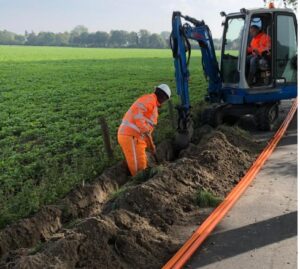
Als Landmeter Kabels en Leidingen ben je verantwoordelijk voor het inmeten en uitzetten van ondergrondse kabel- en leidingnetwerken. Dit betekent onder andere: het bepalen van de exacte positie van bestaande kabels en leidingen in het terrein met GPS/Total Station, het uitzetten van tracés voor nieuwe aanleg en het verwerken van meetgegevens in CAD/GIS-systemen.
Deze rol is essentieel omdat juiste ligging van kabels en leidingen voorkomt dat er graafschade ontstaat, vertraagde aanleg-projecten plaatshebben of onvoorziene kosten ontstaan. Door jouw nauwkeurige meetwerk draag je direct bij aan veiligheid, continuïteit en efficiëntie van infrastructuurprojecten.
Belangrijke vaardigheden zijn onder andere:
Een typische werkdag kan er als volgt uitzien:
Ja, Geo-ICT biedt trajecten waarin je opgeleid wordt voor deze functie en direct aan de slag kunt, bekijk de Geo-ICT Traineeship vacature. Weet je nog niet zeker of je dit wilt maar wil je wel werken in de Geo-ICT? Dan is ons Geo-ICT Traineeship wellicht wat voor jou!
Doorgroeimogelijkheden kunnen bijvoorbeeld zijn: Senior Landmeter Netwerken, Projectleider Kabels & Leidingen of Specialist Geo-Data & Infrastructuur. Door extra kennis te ontwikkelen op het gebied van geo-informatietechniek, leidingnetwerken of meetautomatisering vergroot je je loopbaankansen.
Hoewel het werk primair in het veld (meetwerk) plaatsvindt, geeft kennis van geo-informatie (zoals GIS, geo-databases en locatieanalyse) je duidelijke meerwaarde in deze rol. Je kunt dan meetdata beter verwerken, interpreteren en integreren in digitale systemen.
In deze functie gelden kwaliteitsnormen zoals: correcte opstelling en kalibratie van meetapparatuur, nauwkeurige registratie van kabel- en leidingposities, veilige werksituaties in het veld (terrein/ondergronds werken) en goede documentatie van meetresultaten en revisietekeningen. Ook samenwerking met gangsysteem of KLIC-informatie kan onderdeel zijn.
Je kunt direct solliciteren op de vacature Landmeter (Kabels en Leidingen) of ons Geo-ICT Traineeship of via de pagina’s widget contact opnemen door je naam, e-mail en telefoonnummer in te vullen voor een vrijblijvend gesprek. Ook kun je ons een WhatsApp-bericht sturen. Voor vragen over de inhoud of de functie aansluit kun je eveneens contact opnemen.
